



Property developer websites

Property developer websites built around your portfolio.

Give your marketing team a website that keeps pace with the business. We connect developments, unit information and enquiry journeys so your portfolio can support the next campaign and project launch.

Company websites and development pages for residential, villa and boutique property developers, planned around how buyers and investors explore your projects.

Book a discovery call

Projects from US$5,000 · Typically 4–8 weeks

Selected clients

View work

The starting point

Your database and website shouldn’t tell different stories.

When unit availability, project descriptions and images live away from the website, someone has to update everything twice. Changes wait for a dedicated person, while campaigns send potential buyers to information that may already be out of date.

We plan the content system alongside the public website. Your team gets a practical way to maintain developments and units, while visitors get clearer information and a relevant route to enquire.

Selected work

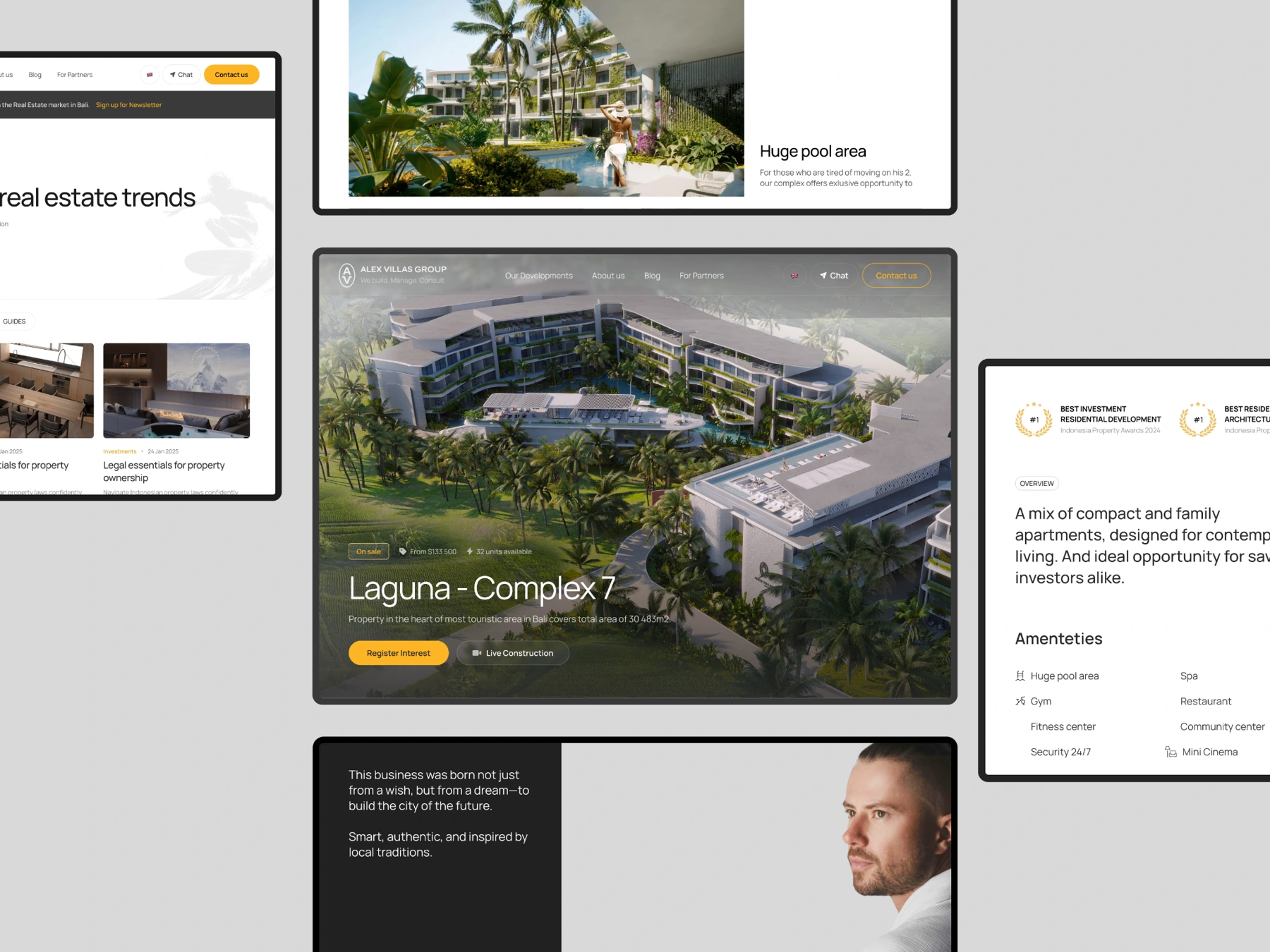
A connected portfolio for Alex Villas Group.

Alex Villas Group website showcase with development pages, amenities and portfolio contentRead case study ↗

Alex Villas needed to move beyond an outdated custom website and disconnected property information. We rebuilt the site in Framer, connected a shared Notion database and delivered the new infrastructure in six weeks.

  • Six-week delivery
  • Notion → website content
  • Independent team updates

Services

The infrastructure behind the portfolio.

  1. 01

    Developer website strategy

    We review your business, current search visibility, portfolio and launch plans. Research informs how the company website, development pages and campaign destinations connect.

  2. 02

    Company and development pages

    The company website establishes your experience. Individual developments need their own useful detail: location, concept, imagery, plans, specifications and a relevant enquiry path, according to the approved materials.

  3. 03

    Development and unit CMS

    Reusable content structures organise complexes, units and their relationships. Fields reflect what your team needs to maintain, rather than requiring a new page layout for every entry.

  4. 04

    Database connections

    We can connect sources such as Notion or another agreed platform to website content. Available fields, publishing rules and sync timing are defined around the integration, reducing duplicate updates.

  5. 05

    Multilingual search and content

    We research how people search in each target language and adapt the content accordingly. Development information stays consistent while the wording and search terms suit each audience.

  6. 06

    Campaign enquiries and measurement

    Project-specific contact paths help visitors ask about the development that interests them. Agreed forms and CRM routing keep that context useful to your team, with tracking to understand contact activity.

Practical details

Give each development the detail buyers look for.

A project page should explain the opportunity and help visitors assess it. We select the right modules from the materials your team can verify and maintain.

The development

  • Location, concept and intended buyer
  • Current project status and delivery information
  • Developer track record and the people behind the project

The property

  • Unit types, layouts and floor plans
  • Specifications, amenities and approved renders
  • Availability and pricing where appropriate for publication

The next step

  • A project-specific register-interest form
  • Brochure access or a viewing request if required
  • Project and unit context passed with the enquiry

How it connects

One content source. A connected project portfolio.

  1. 01 / Source

    Developments + units

    Your team maintains the agreed fields in the source database.

  2. 02 / Website

    Reusable project pages

    Related units, project details and availability appear in consistent templates.

  3. 03 / Sales team

    Enquiries with context

    The enquiry identifies the development or unit that prompted it.

Based on the Notion-to-Framer approach delivered for Alex Villas Group. Fields, sync timing and publishing checks are agreed per integration.

Plan the scope

The right structure for your portfolio.

Company website
Build credibility across completed, current and future developments. Suitable when the business and its track record need one clear home.
Development website
Give a distinct launch its own narrative, campaign destination and enquiry journey. A separate domain is a strategic decision.
Connected portfolio
Use reusable development and unit templates when your team needs to manage several projects and changing information.

Strategy and measurement

Built to support marketing. Measured against its goals.

A developer website needs to serve the campaign and the team behind it. We agree the goals before design and define what can be measured reliably.

Search and project discovery

Track which search queries and development pages attract visitors. Use that evidence to identify where project detail or supporting content needs improvement.

Enquiry actions

Measure successful forms and contact clicks against the relevant project where supported. Review qualified enquiries with the sales team rather than treating every interaction as a lead.

A maintainable portfolio

Define who owns the information, where updates begin and how publishing works. Handover covers the everyday tasks the team needs to perform.

Explore our real estate SEO approach ↗

From the founder

“After two years of struggling with agencies and freelancers, he came in with a clear plan and delivered in just six weeks.”

Alex ShtefanFounder, Alex Villas Group
Read the Alex Villas Group case ↗

Our approach

A clear plan, from discovery to handover.

  1. 01

    Understand the business

    We start with your goals, current website, marketing activity and the questions your prospective clients need answered. An audit identifies what to retain, improve or replace.

  2. 02

    Plan the portfolio and data

    We map company pages, developments, units and enquiry routes. Search research shapes the sitemap, while a review of the existing database identifies what can be connected and what needs organising.

  3. 03

    Build a connected website

    We develop the content, visual direction, responsive pages and editing workflow together. Enquiry routes and agreed integrations follow how your team actually works.

  4. 04

    Launch, measure and hand over

    We test the website, redirects and contact paths, verify tracking and train your team. You receive progress updates a couple of times each week throughout the project.

Team control

Update the source. Keep the portfolio connected.

For Alex Villas, the team maintains development and unit information in a Notion database connected to the Framer website. Updates flow through the integration, reducing the need to maintain separate versions of the same content.

The founder also uses a connected Claude MCP workflow to edit website content. We can scope similar AI-assisted workflows where supported, with access and publishing responsibilities agreed during handover.

See how it works for Alex Villas ↗

Scope and investment

A defined project. A clear starting point.

Starting investment
US$5,000
Typical delivery
4–8 weeks

Your proposal defines the website strategy, design and development, editable content, technical SEO, enquiry tracking and handover appropriate to your project.

Languages, database connections, custom features, migration and content preparation shape the final quote. Ongoing SEO and maintenance are agreed separately.

Book a discovery call

Questions before we start

The details that help you decide.

Can you connect our current property database?

We assess the platform, available access, fields and content relationships before recommending an integration. Notion is one option we have used for Alex Villas. Other systems depend on their capabilities and the agreed scope; sync frequency and publishing rules are defined before implementation.

Do we need a company website or separate websites for developments?

That depends on your portfolio, audiences, launch plans and existing search visibility. We recommend a connected structure after discovery. A dedicated development website is useful when it has a distinct purpose and enough information to support it.

Can our team update availability without a developer?

That is a core requirement we plan for. The CMS or connected database gives authorised team members a defined editing workflow. We demonstrate the agreed update process at handover, including any AI-assisted tools supported by the chosen setup.

How long does a website project take?

Most projects take 4–8 weeks. Alex Villas Group was delivered in six weeks; D5’s initial website work took approximately four to five weeks. The schedule depends on the agreed pages, integrations, available materials and feedback. Ongoing SEO and maintenance follow a separate scope.

How much does a project cost?

Website projects start from US$5,000. After discovery, your proposal sets out the deliverables, measurement plan, timeline and price. Page count, languages, content preparation, migration and integrations shape the final scope. Hosting and third-party subscriptions are confirmed separately.

Do you write the content?

We usually prepare or refine the website copy, unless your team prefers to own it. We gather useful information from your existing website, social channels and supplied materials to reduce repeated requests. Your team confirms project facts, permissions and missing details before publication.

What happens after launch?

Your team receives a handover session for everyday updates. Ongoing SEO and website maintenance are available through an agreed monthly scope. We can review search visibility, visitor behaviour and enquiry actions to recommend the next improvements.

Can you show floor plans, brochures and construction progress?

Yes, where those assets are available and approved. We can structure floor plans, downloadable brochures, galleries and construction updates within the CMS. Interactive masterplans, complex unit filters and live inventory feeds require a separately defined scope.

Do you create the architectural renders and investment figures?

Our website scope uses your approved project assets and verified commercial information. New 3D production can be discussed separately. Your team approves pricing, availability, completion dates and any investment claims before publication.

Start a conversation

What does your next development launch need?

Bring your current website, portfolio and the tools your team uses to manage project information. We’ll discuss what needs to connect.

Book a discovery call WhatsApp ↗